
Software designed around how your business actually works.
We build web, mobile and backend systems for workflows, users and operational constraints that off-the-shelf software cannot fully address.
How it works
Build what creates differentiation or removes meaningful friction.
Custom software should not exist simply because it can. It is most valuable when the workflow is unique, existing tools create too many compromises or the product itself is part of the competitive advantage.
-
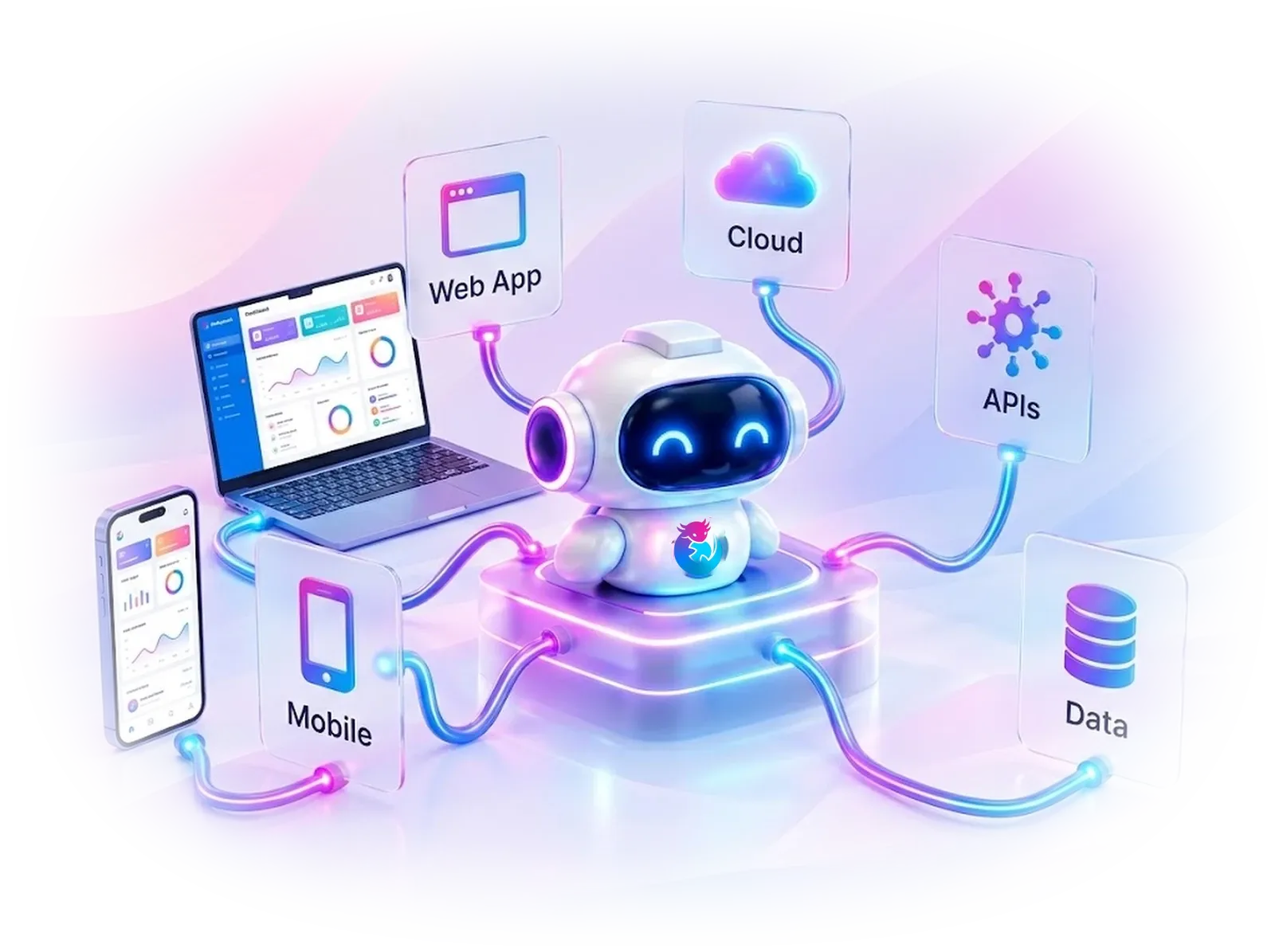
Customer and employee-facing web applications.
-
Backend services, APIs and domain platforms.
-
Modernization of legacy business-critical systems.
-
AI capabilities embedded into existing software products.
The system
A product stack with explicit boundaries from experience to operations.
Custom software works best when user experience, domain logic, integration and platform concerns are separated clearly enough to evolve independently.
Domain-first boundaries
Business rules do not disappear into UI code, integration glue or vendor-specific infrastructure.
Integration is designed
External systems get explicit contracts, failure handling and ownership instead of ad-hoc calls.
Operability is a feature
Logging, tracing, security and deployment are part of the application architecture.
Where projects stall
Build when the workflow, product or domain is part of your differentiation.
-
Off-the-shelf tools force too many compromises
If teams work around the software with spreadsheets, duplicate entry or manual handoffs, the operating model is already paying the cost.
-
Legacy systems slow every change
Modernization should protect valuable domain logic while creating cleaner boundaries for new experiences and integrations.
-
Product and platform decisions are disconnected
A good user experience depends on the domain model, APIs, data contracts and operational architecture behind it.
What we build
From product experience to production infrastructure.
We can work across the stack or focus on the layer where your team needs the most leverage.
-
Web applications
Responsive product experiences, portals and operational tools designed around real user journeys.
-
Mobile experiences
Mobile applications and companion experiences that stay connected to the same product and platform strategy.
-
APIs & backend platforms
Domain services, integrations and business logic designed for maintainability, testing and scale.
-
Cloud foundations
Deployment, observability, security and infrastructure aligned with the application lifecycle.
How we work
Product thinking and engineering move together.
The best software decisions happen when user experience, domain logic and technical constraints are considered at the same time.
- 01
Discover
Clarify users, workflows, business rules, integrations, success criteria and what not to build.
- 02
Shape
Define the product slices, architecture and technical boundaries needed for an effective first release.
- 03
Ship
Deliver production-ready increments with testing, observability and deployment built into the process.
- 04
Improve
Use product feedback and operational data to prioritize the next improvements instead of guessing.
Modern does not mean disposable.
What you get
Experience, architecture and operations move together.
Every engagement ships these layers as working, documented parts of the system, not slides.
- Layer 4
Product shaping
User journeys, domain workflows, release slices and the smallest useful first version.
- Layer 3
System design
Domain boundaries, APIs, data contracts, security, integration and scalability decisions.
- Layer 2
Delivery system
Automated testing, CI/CD, environments, telemetry and release practices that support continuous change.
- Layer 1
Operational ownership
Runbooks, monitoring, support considerations and knowledge transfer for the team that will own the product.
Where to start
Software around the parts of the business that are actually unique.
We can own a product slice end to end or work with an existing team on the layer where additional leverage is needed.
-
Customer portals
Self-service experiences that bring data, workflows and communication into one coherent product.
-
Internal operational tools
Purpose-built interfaces for complex workflows where generic systems create too much friction.
-
Backend platforms & APIs
Domain services, integration layers and reusable business capabilities designed for maintainability.
-
Mobile experiences
Companion or primary mobile products connected to the same business and platform strategy.
-
Legacy modernization
Incremental modernization that creates better boundaries without forcing a risky rewrite of everything at once.
-
AI inside existing products
Retrieval, copilots and intelligent workflows embedded where users already do their work.
Before we start
Questions we hear first.
Practical answers. The exact architecture depends on the workflow, constraints and systems already in place.
Do you build full products or only backends?
Both. We can work across web, mobile, APIs and cloud infrastructure or focus on a specific layer when an internal team already owns the rest.
Can you modernize without rewriting everything?
Yes. Incremental modernization is usually safer: identify seams, isolate business capabilities, introduce cleaner interfaces and move functionality in deliberate slices.
Can AI be added later?
Yes, and often that is the right approach. Good data boundaries, APIs and observability make it easier to add AI capabilities later without destabilizing the core product.
How do you decide what belongs in the first release?
We prioritize the smallest end-to-end workflow that proves user value and technical feasibility, while deliberately postponing breadth that does not change the learning.
Tell us what you want to build.
We reply within one business day — a person from the team, not an autoresponder.