
Build digital products with intelligence at the core.
From discovery to production architecture, we help teams turn AI capabilities into focused SaaS and digital experiences people can understand, trust and actually use.
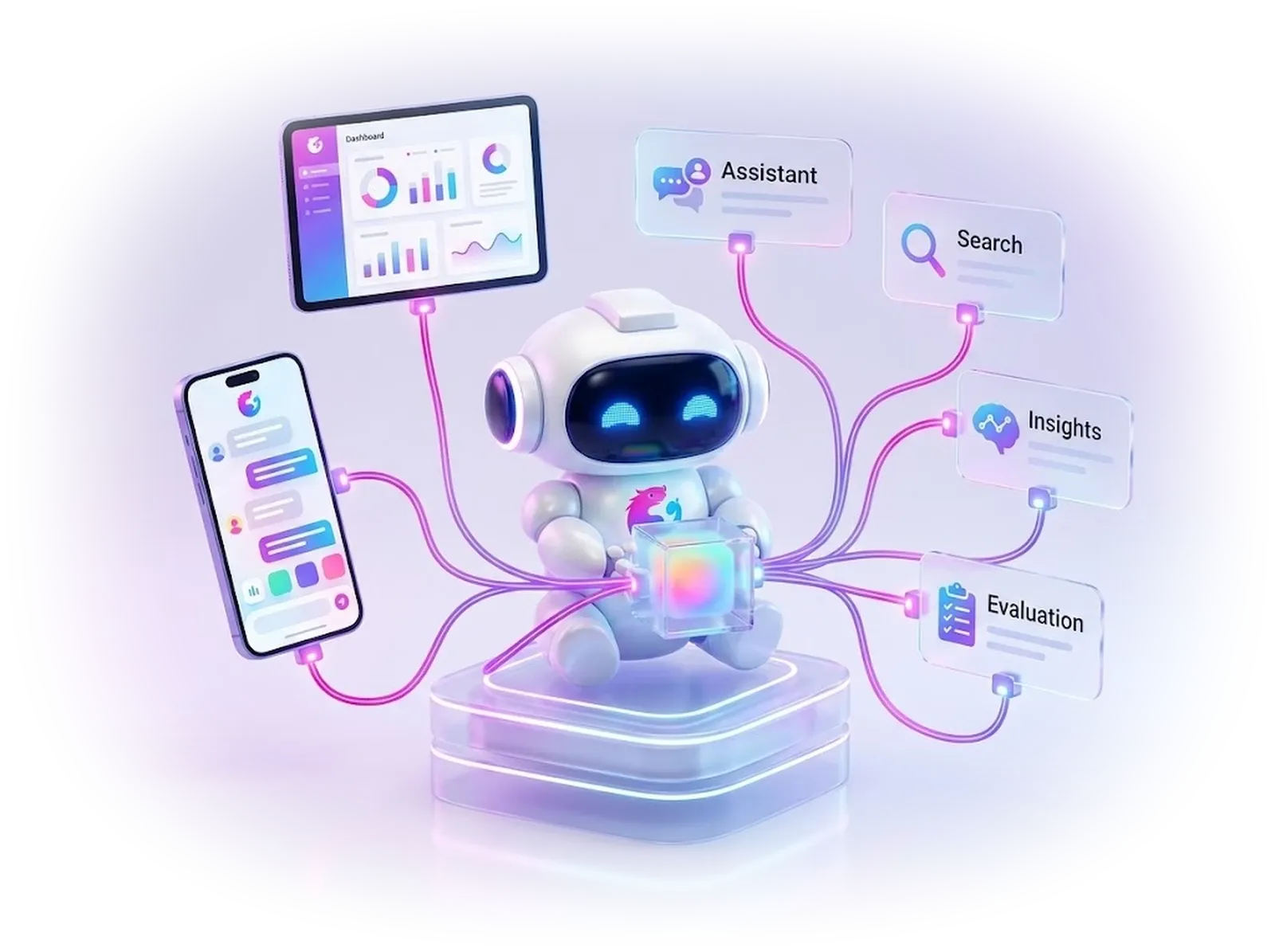
How it works
A useful AI product is more than a model behind a chat box.
The product has to make intelligence understandable, controllable and valuable inside a real user journey. That means product design, evaluation and architecture need to evolve together.
-
Define the user problem before choosing the model.
-
Design uncertainty, feedback and control into the experience.
-
Build evaluation into product development from the start.
-
Plan for cost, latency, observability and model change.
The system
Intelligence is one product capability inside a larger experience.
Successful AI products combine a strong user loop with context, model orchestration, evaluation and a platform that can be operated after launch.
Design the user loop
AI capability is shaped around a task, feedback loop and level of user trust.
Evaluate continuously
Quality, safety and product metrics are measured as models, prompts and context evolve.
Plan for model change
Routing and abstraction reduce the cost of changing models when capability or economics shift.
Where projects stall
The feature has to improve the product experience, not just showcase the model.
-
AI is bolted on instead of designed in
A chat box is not automatically a useful product experience. The interaction model should match the user task.
-
The product has no evaluation strategy
Teams need examples, feedback loops and quality signals before they can improve behavior intentionally.
-
Model limitations leak directly to users
Good product design makes confidence, fallbacks, citations and human escalation part of the experience.
What we build
From concept to an AI-native product experience.
We combine product strategy, application engineering and AI architecture instead of treating them as separate workstreams.
-
Product discovery
Identify where AI creates a genuine product advantage and define the smallest experience worth testing.
-
AI experience design
Design prompts, feedback, uncertainty, approvals and context as part of the user experience.
-
Application architecture
Build the product shell, domain logic, data and integration layers around the AI capability.
-
Evaluation & product telemetry
Measure quality and user outcomes so model behavior can be improved with evidence.
How we work
Validate the behavior before scaling the platform.
AI product risk is reduced by testing the core experience early and learning where the model genuinely helps users.
- 01
Frame the product bet
Define the user, problem, AI advantage and behavior that would make the experience meaningfully better.
- 02
Prototype the interaction
Test the model, context and UX together rather than validating them in isolation.
- 03
Build the production loop
Add application architecture, evaluation, permissions, observability and cost controls.
- 04
Learn from usage
Use behavior and feedback data to improve prompts, retrieval, model selection and the product itself.
The experience around the model is where the product lives.
What you get
The interaction layer and the intelligence layer need to evolve together.
Every engagement ships these layers as working, documented parts of the system, not slides.
- Layer 4
Experience design
Interaction patterns, confidence cues, citations, editing, approval and fallback behavior around AI output.
- Layer 3
Context architecture
Retrieval, user state, domain data and permissions shaped around what the feature actually needs.
- Layer 2
Evaluation system
Representative examples, human review, automated checks and telemetry that make quality measurable.
- Layer 1
Model strategy
Routing, model selection, latency and cost decisions driven by the product experience rather than provider preference.
Where to start
AI that becomes part of how users complete the job.
The best pattern depends on whether the user needs answers, transformation, recommendations or coordinated action.
-
Semantic search & answer experiences
Help users find the right information across domain content with grounding and visible provenance.
-
Copilot experiences
Assist users inside an existing workflow with drafting, transformation, explanation and next-step guidance.
-
Agent-driven experiences
Let the product coordinate tools and tasks when the workflow benefits from bounded autonomous action.
-
Intelligent data experiences
Summarize, classify and explain complex information in ways that are easier for users to act on.
-
Multimodal interactions
Use text, image or document inputs where richer context improves the workflow.
-
Adaptive product behavior
Use feedback and evaluation data to improve prompts, retrieval, routing and model selection over time.
Before we start
Questions we hear first.
Practical answers. The exact architecture depends on the workflow, constraints and systems already in place.
Should every AI feature be conversational?
No. Inline suggestions, structured transformations, search, recommendations and background agents can be better interaction patterns than a chat interface.
How do you measure AI product quality?
We combine task-specific evaluations with product signals such as completion, editing, abandonment and escalation. The right metric depends on the user outcome.
Can different models power different parts of the product?
Yes. Routing by task can improve quality, latency or cost when the complexity is justified and the evaluation layer can support it.
How do you handle uncertain output?
The product can expose sources, ask for confirmation, offer editing, narrow the action scope or escalate to a person depending on the consequence of being wrong.
Tell us what you want to build.
We reply within one business day — a person from the team, not an autoresponder.