

Chatbot or Agent: What Does Your Business Need?
More and more companies want to “add AI” to their operations, but they often arrive with a fuzzy idea: sometimes they ask for a chatbot when they actually need an agent, and other times the opposite. Although the terms are used interchangeably, they solve different problems. Choosing well is the difference between an investment that creates value and one that only adds noise.
What is a chatbot?
A chatbot is a conversational interface. Its job is to answer: it receives a question and returns information. It can be based on predefined flows and rules, or rely on a language model to respond in natural language over a scoped knowledge base.
Its typical characteristics:
- It is reactive: it acts only when the user types something.
- It has a narrow scope: frequently asked questions, first-level support, product information.
- It does not execute actions on its own; at best, it hands off to a human or another system.
What is an AI agent?
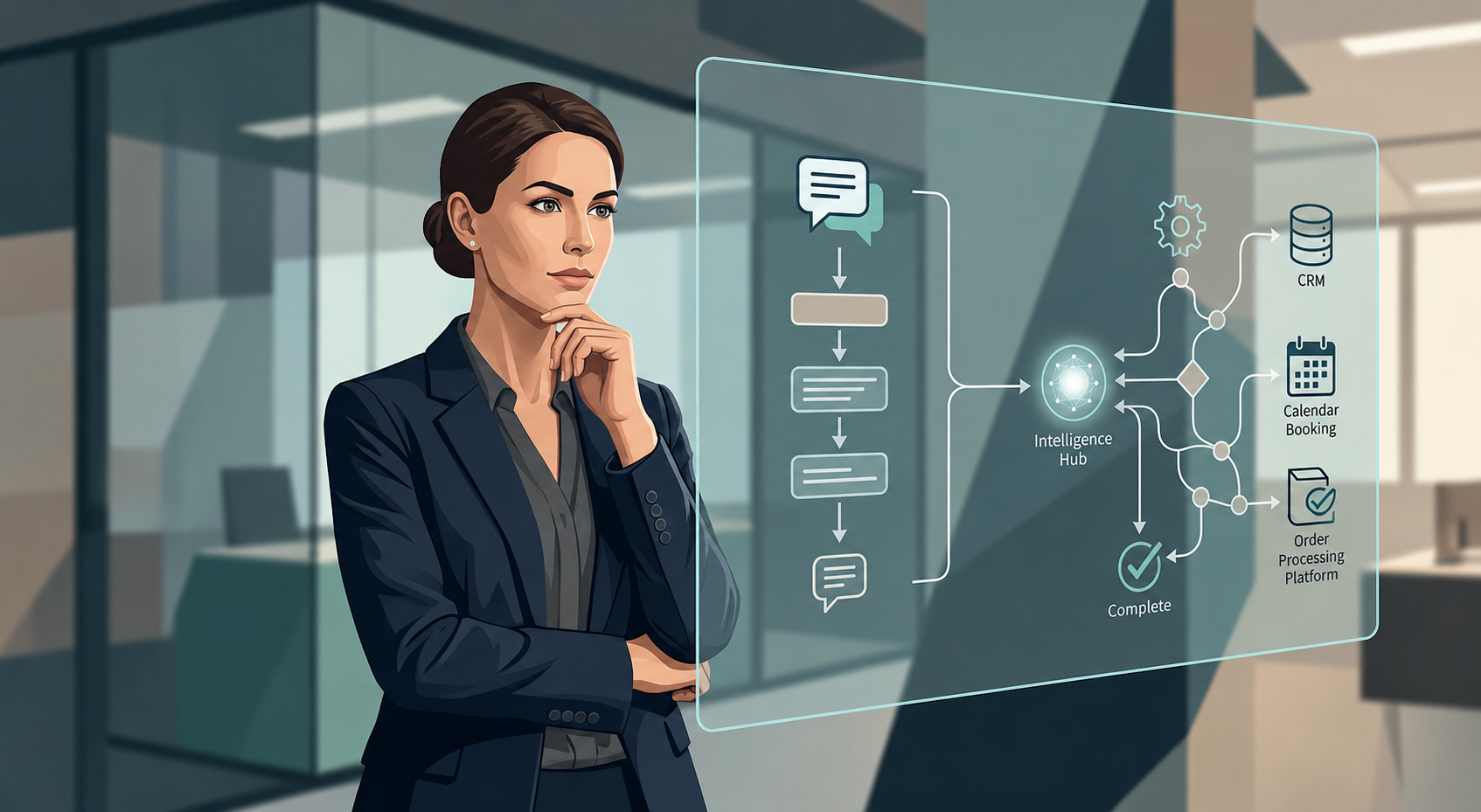
An AI agent goes a step further: it does not just answer, it decides and acts. It receives a goal, breaks it down into steps, uses tools and APIs, queries internal systems, and executes multi-step tasks until they are completed.
Its typical characteristics:
- It is autonomous: it plans and makes decisions to reach a goal.
- It integrates with your systems: CRM, ERP, database, email, calendars.
- It executes real tasks: scheduling, generating a report, creating a ticket, processing a request end to end.
Key differences
- Autonomy: the chatbot reacts; the agent plans and acts.
- Scope: the chatbot informs; the agent resolves and executes.
- Integrations: the chatbot usually lives in isolation; the agent is connected to your operation.
- Complexity and cost: a chatbot is faster and cheaper to implement; an agent requires more design, integration, and governance.
”The right question is not ‘do I want AI?’, but ‘what problem do I need to solve, and how much autonomy should the solution have?’”
When does a chatbot make sense?
- You need to reduce support load by answering frequently asked questions.
- You want to guide visitors on your site or capture leads.
- The use case is informational and does not require executing actions in your systems.
- You are looking for a solution that is quick to implement and low cost.
When does an AI agent make sense?
- The process has multiple steps and currently depends on manual intervention.
- The solution needs to read from and write to your systems (CRM, ERP, databases).
- You want to automate complete tasks, not just answer questions.
- The value is in the execution, not only in the information.
Do you have questions about how to start your project?
We accompany you every step of the way.
Contact Us It is not always one or the other
In many cases the best answer is a combination: a chatbot as the conversational entry point, backed by an agent that executes the tasks behind the scenes. The user converses naturally while the autonomous logic does the real work.
Conclusion
The decision should not be driven by the trend of the moment, but by the specific problem you want to solve and by how much autonomy the solution needs. A chatbot is ideal for informing and guiding; an agent, for automating and executing.
At Ambystech we help companies make this decision with judgment: we analyze the use case, the expected return, and the integration complexity to implement exactly what your business needs—no more, no less.